
How I Teach Brand New Players
I have always felt the best way to teach a game is to give new players just enough information to understand what you are playing with, then diving into a game explaining what you are doing along the way. Games are meant to be fun, so teaching should be fun from the start! Even complex games can be learned with this method, assuming one person who knows how to play is guiding the other players through their first plays. Modern video game developers know this is the best approach. Most new video games start immediately with a playable tutorial where you start playing through the game while the app gives you pointers on what to do. From the get go, you are having fun and learning the rules. These tutorials first show you the basic commands and moves, then introduce more complexity as you become comfortable while you are playing. When I teach Mah Jongg, I try to follow this method, and I have found the Card Free rules work really well with this approach.
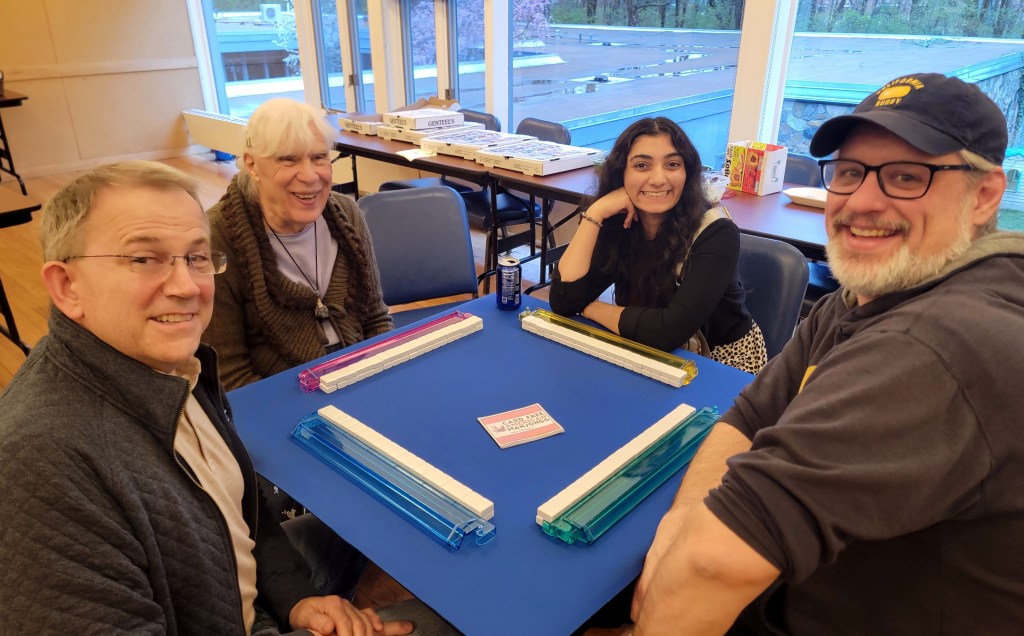
I really enjoy teaching Mah Jongg to new players. I have taught standard NMJL rules to groups, and I have now been teaching new players Card Free American Mah Jongg. I truly feel the rules of Card Free allow for an approach to teaching the game that is incremental, easily digestible, and quick to start playing. The challenge of teaching NMJL Mah Jongg with the card is that you kind of need to understand the entirety of the card before you can really use it. I’ve seen great Mah Jongg teachers use certain techniques like only focusing on a few categories, or even making their own simplified cards as teaching tools, which I think is a great way to help ease people into learning the card. But learning the card can still be daunting, especially the challenge of internalizing the quirks of how to understand the card itself. I think this does make it hard to sit down and have fun from the start.
My strategy is to begin with a very basic version of the game, teaching as we play, then over time adding more rules and as the players internalize what they have learned. Generally I give a brief lesson to introduce new rules between each game, then play a game with those new rules added to the existing rules I have already taught. Learning while playing helps reinforce all of the rules players have learned and it is more fun! My goal is to have players feel from the first time they touch the tiles that they are playing a game, not doing an exercise.
The great advantage of teaching Card Free to new players is the flexibility of building hands. You don’t need to introduce all 10 of the standard patterns and all of the set categories, you can start with just one pattern and start playing. I teach some patterns first, ignoring categories completely, then once they have a few of the easiest patterns down, I start teaching them how categories work. The first game we play, the only rule is you have to make a 2-Pung 2-Kong hand. Focusing on just that rule, they learn pungs, kongs, jokers, and the rules of picking, discarding, calling tiles, and calling Mah Jongg. After a game or two, I will then introduce the patterns of 1-Pair 3-Kong and 1-Pair 4-Pung. Introducing these new patterns builds on their knowledge of pairs and kongs, and adds the special rule that pairs cannot be called except for calling Mah Jongg. As we play more games, I will introduce more rules and concepts until everyone is comfortable with all of the rules.
I taught Card Free to a new group recently, and here’s the rough order that I explained concepts in. As you can see, we started playing quickly, and introduced concepts gradually. I started with all of the tiles face up organized by suit so I could explain the tiles, then we jumped right into our first game.
Introductory explanation before playing:
- Teach the tiles:
- There are 4 of each tile
- Explain the suits, flowers, dragons, and winds
- Explain the different kinds of tiles have different rules which I will explain eventually, however to start just know you are trying to make groups of identical tiles.
- Explain basic gameplay:
- You pick a tile, then discard a tile going agame clockwise
- You start with 13 tiles in hand, but need to make a 14-tile hand with the last tile you pick.
- That 14-tile hand will be made up of groups of identical tiles
- Explain Pungs and Kongs:
- Explain a Pung, can use “Triplet” or “3-of-a-Kind” if they want
- Explain a Kong, can use “Quad” or “4-of-a-Kind” if they want
- Explain Calling / Exposing
- Explain that you can call a tile to make an exposed Pung or Kong during gameplay
- When you do you expose the Pung or Kong
- Explain you cannot change the Pung or Kong after it is exposed
- Explain how turns are skipped with calling
- Explain you must discard after calling.
- Explain a winning hand
- Explain building a hand of 14 tiles using 2 Pungs and 2 Kongs
- Demonstrate a sample winning hand
- Ask players to build a winning hand.
- Explain there is a lot more to learn, but we’ll start playing to get a sense of how it works and I will add more rules as we go.
Set up the first game:
- Flip over the tiles and shuffle
- Explain that this is the time to talk about how annoying our spouses are or gossip about our neighbors.
- Build the walls.
- You as the dealer push your wall out first
- Do not use dice, this can be introduced later
- Have all players draw their hands of 13 tiles
- You as the dealer, draw only 13 tiles to start so you can demonstrate picking from the wall at the start of your turn.
- Invite the players to organize their hands in suit and numerical order, with special tiles to one side or the other of their rack.
Play Game* #1:
*For this teaching plan, a “game” is one hand of Mah Jongg
Rules to use this game:
- No Charleston (don’t even mention it until a future game)
- No breaking wall with dice
- You are dealer, draw only 13 tiles
- No Joker Swap
- A winning hand is any combination of 2 Pungs 2 Kongs, no category needed
Tips for teaching:
- Start the game by drawing your first tile from the wall and discarding to demonstrate how it works for other players.
- Narrate everything that is happening, reminding them of the rules.
- Suggest players count their tiles frequently to make sure they have 13. Keep it casual, if someone made a mistake let them fix it.
- Have players count out loud 1,2,3 before taking a tile from the wall. I usually have players ask “Anyone want the last tile” before picking from the wall, just to give the new players time to think about calling a tile.
- Hopefully someone goes Mah Jongg, but if they don’t play again with these rules until someone does.
Play Game #2:
Quick Lesson before playing:
- Explain a Pair:
- No Jokers in a pair
- Can’t call a tile for a pair except for Mah Jongg
- Explain a NEWS block
- No Jokers in a NEWS block
- Can’t call a tile for a NEWS block except for Mah Jongg
- Allow 2 more patterns, 1 Pair 4 Pungs and 1 Pair 3 Kongs
Rules to use this game:
- No Charleston
- No breaking wall with dice
- You are dealer, draw only 13 tiles
- A winning hand is any combination of these patterns, no category needed:
- 2 Pungs 2 Kongs
- 1 Pair 3 Kongs
- 1 Pair 4 Pungs
Tips for Teaching:
- If a joker swap scenario comes up while playing, teach them that.
- Keep doing the same teaching tips from above
- Hopefully someone goes Mah Jongg, but if they don’t play again with these rules until someone does.
Play Game #3:
Quick lesson before playing:
- If Joker Swap hasn’t come up, teach that
- Explain concept of Set Categories:
- At least 3 numbers in consecutive order for the blocks of the pattern
- Suits must be next to each other in number order, no braided or woven hands
- First categories:
- Consecutive Run
- All 4 Winds
- Explain Flowers and Dragons:
- They fill in the blocks of the pattern not used by the set
- Flowers can only be used in Pairs
- Only One flower block per hand
- Only One block of each dragon per hand
- Explain the dealer is the next person to the right and they draw 14 tiles at start.
Rules to use this game:
- No Charleston
- No breaking wall with dice
- Player to right of you is dealer, draws 14 tiles
- A winning hand requires a valid pattern and valid set:
- Patterns:
- 2 Pungs 2 Kongs
- 1 Pair 3 Kongs
- 1 Pair 4 Pungs
- Categories:
- Consecutive Runs
- All 4 Winds
- Patterns:
Play Game #4:
Quick lesson before starting:
- Explain the rest of the numbers sets: Odd, Even, 369, Like numbers
- Explain the Opposite Wind NS, EW sets
- Explain Quints
- Explain the official pattern rule:
- Block Types: Pair, Pung, Kong, Quint
- Any 2 block types adding up to 14, or all pairs
- This creates 10 different pattern types (I provide a small reference card for players)
Rules to use this game:
- No Charleston
- No breaking wall with dice
- Player to right of you is dealer, draws 14 tiles
- A winning hand requires a valid pattern and valid set:
- Patterns:
- 2 Pungs 2 Kongs
- 1 Pair 3 Kongs
- 1 Pair 4 Pungs
- Categories:
- Consecutive Runs
- All 4 Winds
- Patterns:
After playing these 4 introductory games, the next two big steps are to explain the Charleston and Scoring. It will depend on the group you are playing with when you want to introduce those elements. Your group may be ready to take these on right away, or you may be having enough fun with what you already know.
I hope this plan above gives you some ideas for how to teach Card Free American Mah Jongg. I’d love to hear your suggestions for how you teach new groups.
 Card Free American Mah Jongg
Leave a comment